|
Bearing care and maintenance.
CAUTION
If you use bearings completely dry without lube they can eventually get damaged.
Run them dry at your own Risk!!
Bearings need to be Cleaned and Lubed over time and
extended use.
This applies to ceramic bearings as well.
If you're serious about cleaning your bearings I
recommend investing in a Sonic Cleaner.
I recommend Simple Green .. the clear
Crystal formula, as the solution, slightly diluted.
Short of that, here's more info on cleaning and bearing care.
When using Solvents and Compressed
air, use all... Safety Precautions ...
associated with Chemicals and use Safety Glasses
when using Compressed air.
If you're not sure of what to do, ... find out!
Better safe than Sorry!
If you have questions let me know.
Shields need to be removed to clean the bearing properly.
This will help insure foreign particles do not remain in the bearing.
Once I received a bearing back from a customer having a problem
and after opening the bearing found a 3 inch long strand of hair inside
and the bearing simply needed to be cleaned.
Even with the shields on, dirt and string lint can get into a
bearing.
Remove the shields and clean the bearing in a solvent.
Paint thinner or grease remover such as Gunk .... Engine Degreaser can be
used..
and found in auto supply
stores.
But keep in mind they can
evaporate too fast and leave
dry residue in the bearing that
causes the bearing not to spin freely after cleaning.
Once the bearing has been cleaned it's best
to use compressed
air to spin it dry.
The air will also help remove anything still in the bearing before adding lube.
To Lube the
bearings for Unresponsive play.. Ceramic or otherwise.
I recommend Thin YoYo Jam oil and only enough so it's not dry.
A tiny drop of oil worked into the balls inside will allow it to still spin
unresponsive.
Put some
oil on the end of a toothpick or pin.. not even enough so it looks like a drop...
just so it is wet from the oil. Then keep touching it to the balls in the
bearing and spin the bearing with your fingers to work it in.
~~~~~~~~~~~~~~~~~~~~~~~~~~~~~~~~~~~~~~~~~~~
Although designed for minimum response for the most in advanced play...
Dif-e-Yo's can be set up for more response if needed.
Dif-e-Yo's respond best with Slick 6 string.
With any yoyo.. a Fresh string is
always best
and don't let it get too tight.
Let the yoyo hang and untwist the string every so often and you'll see a
difference in play until it gets twisted tight again.
100% Cotton string is stiffer and will not create as much response.
If you do Not want more response... 100% Cotton works well but...
with the variety of new types of string available now you may find a different
string
suits your play better, so experiment to find a string that works best for you.
Lubing a bearing will increase response considerably and is the most effective
method.
Brain Lube is the recommended Lube if you desire more response!
Though some spin time will be lost you will find with the KonKave bearing
it's not enough to hinder play and the yoyo will still be smooth playing and
return easier.
Other options for more response are .030" thick Dif-Pads
offered
as an "option" to
the original .015 thick Dif-pads for Dif-e-Yo yoyos.
For Maximum Response... precut Duncan Friction stickers work well.
~~~~~~~~~~~~~~~~~~~~~~~~~~~~~~~~~~~~~~~~~~~~~~~~~~~~~~~~~~~~~~~~~~
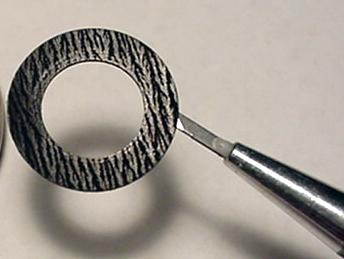
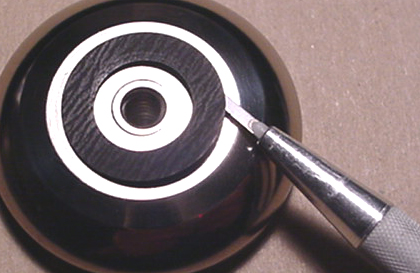
Dif-Pad Installation
Using the "tip" of a thin knife , X-acto
blade or even a toothpick , ..
put the edge of the Dif-Pad on the tip of the tool your using.
Place the pad over the yoyo and eyeball how it lines up before pressing it
on.
The Dif-Pads won't stick solid until you press hard and with this in mind, ..
lay the pad gently onto the yoyo until it is lined up.
Then press the whole pad with your thumb to seat it and then remove the tool.
Also before pressing hard to seat it totally... you can push from the center
hole outward while working your way around which will slightly stretch and
move the inner hole away from the bearing a little more and then press it
solid.
~~~~~~~~~~~~~~~~~~~~~~~~~~~~~~~~~~~~~~~~~~~~~~~~
Looking for Smooth play with less
response and
a response system that lasts.
Dif-Pads
They play like half worn friction stickers right from the start
and stay that way. Will fit any yoyo that uses Friction stickers.
After extended play the Dif-Pads will
seem like they have no response at all and what you will find is the pads are ok
and that it's the string that needs to be replaced to get some response again.
"Response varies in different yoyo's."
Experience the
Dif-ference.
~~~~~~~~~~~~~~~~~~~~~~~~~~~~~~~~~~~~~~~~~~~~~~~~
Dif-Pads
It's a personal preference as
to how long you want to leave the Dif-Pads on
as to how thin they get after prolonged use.
If you go by how the yoyo is working compared to what the pads look like,
that is usually why or when you might want to change them.
The pads are the same material all the way through and only look different on
the surface when new from the manufacturing process.
The response properties are much the same throughout the life of the
pads.
|